🌈 ESP32-S3 Rainbow: ZX Spectrum Emulator Board! Get it on Crowd Supply →
View All Posts
read
Want to keep up to date with the latest posts and videos? Subscribe to the newsletter
HELP SUPPORT MY WORK: If you're feeling flush then please stop by Patreon Or you can make a one off donation via ko-fi

I’ve been picking up a whole bunch of these motion sensitive night lights and, let’s just say, they haven’t been great. The range is poor, the battery life is nowhere near the advertised “charge it four times a year”, and the timeout is so short it’s not even enough time to get to the toilet.

I thought it might be interesting to crack one open and see if I could improve it.
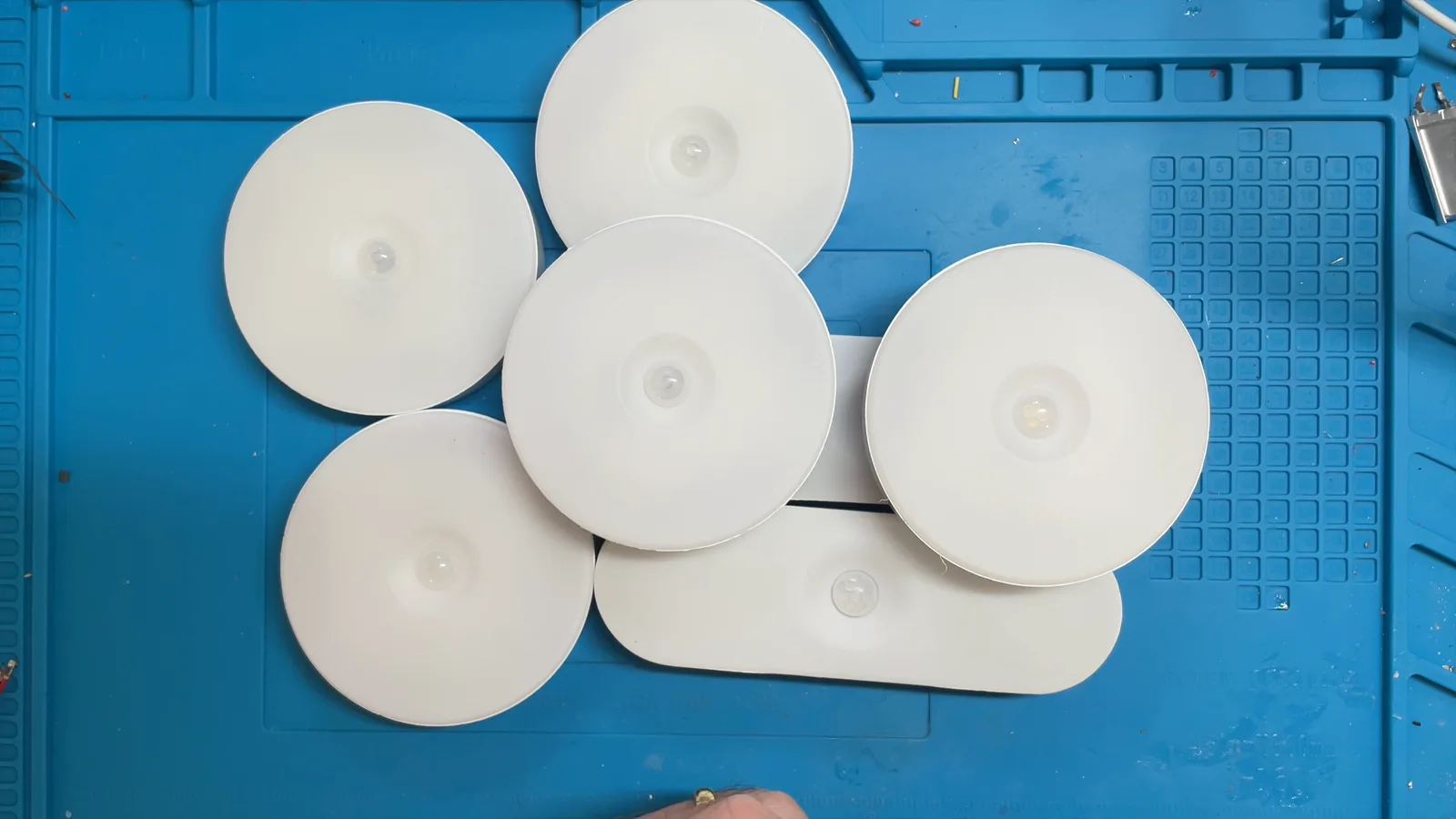
A pile of cheap motion sensor night lights

I’ve got both flavours — round ones and oval ones — and internally they’re basically identical, so whatever I do to one should work for both. (Those are affiliate links — if you pick a pair up through them, I get a few pennies at no extra cost to you.)

The Plan

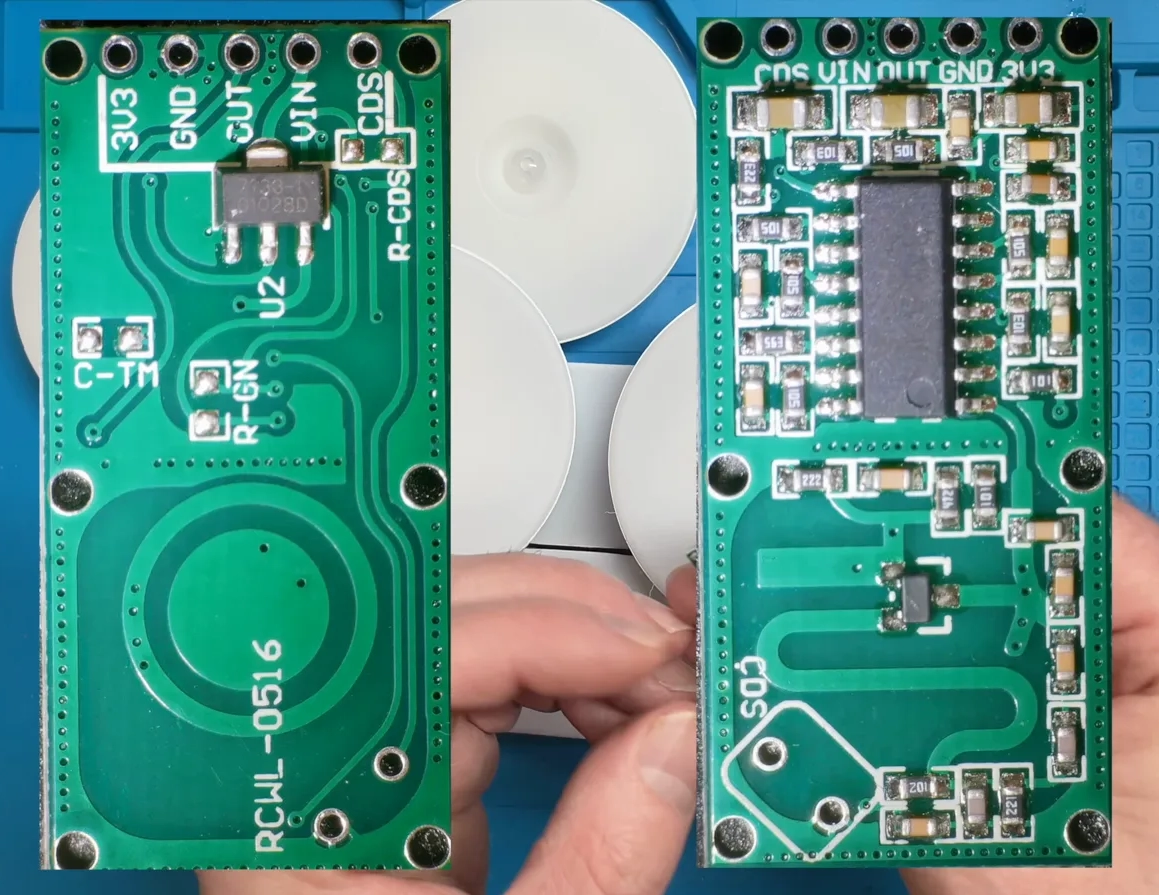
I’ve got a drawer full of these nice little RC-WL0516 microwave radar sensors. They’re much more sensitive than a PIR, they see through plastic, and you can tweak the sensitivity and timeout with a couple of passives. The idea is to rip the original motion sensing front end out of one of these night lights and drop the radar module in instead.

RC-WL0516 microwave radar modules

Cracking One Open

The top just pops off with a bit of a squeeze. Inside, there’s a PIR sensor, an eight pin mystery chip with all the identifying marks sanded off, a light dependent resistor, and some charging circuitry.
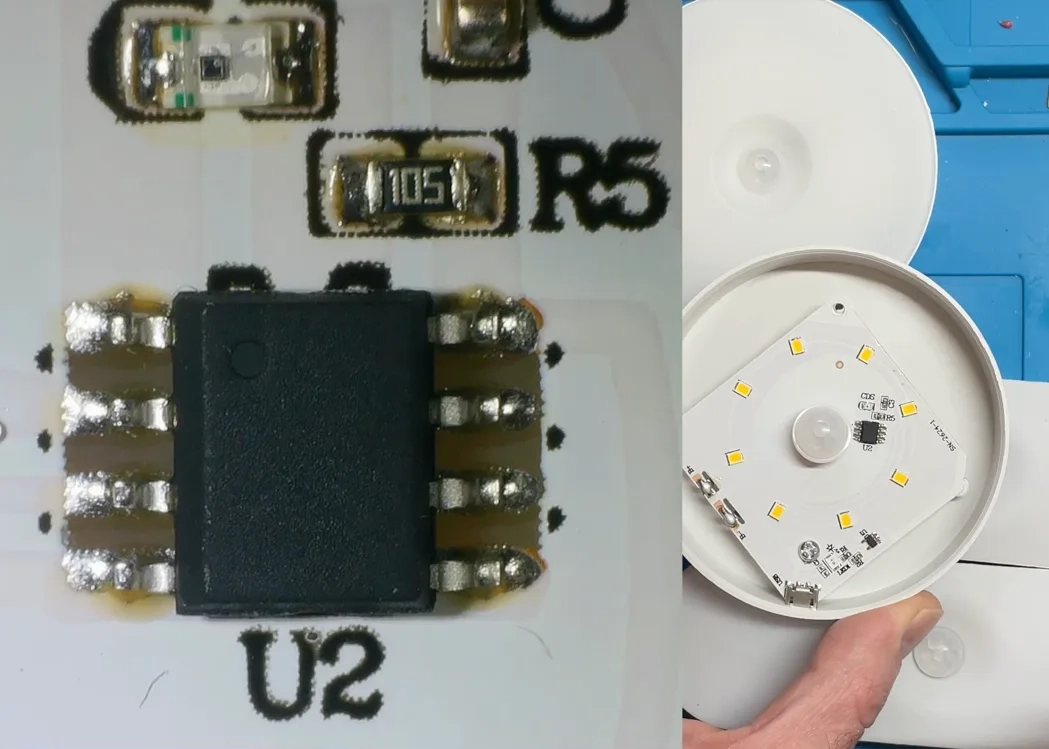
Inside the night light, with U2 mystery chip close-up

Popping the single screw out releases the board. Underneath is a tiny 350 mAh lithium cell — and no sign of a protection board on it, which is always reassuring.
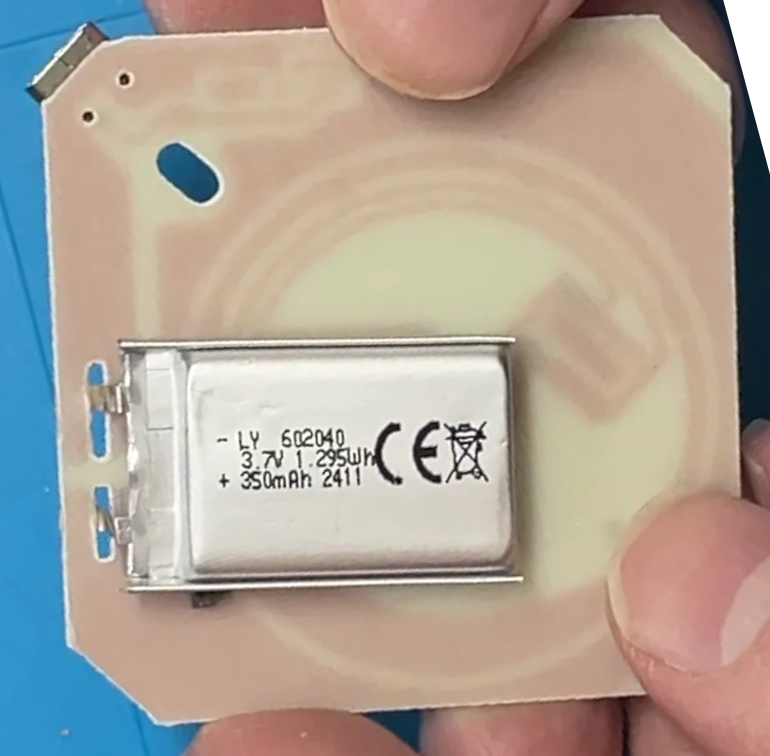
The 350 mAh lithium cell

With the board out, the layout is pretty clear. PIR sensor dead centre, ring of LEDs around it, mystery chip off to one side next to the LDR, and the charging circuitry tucked down by the micro USB port.
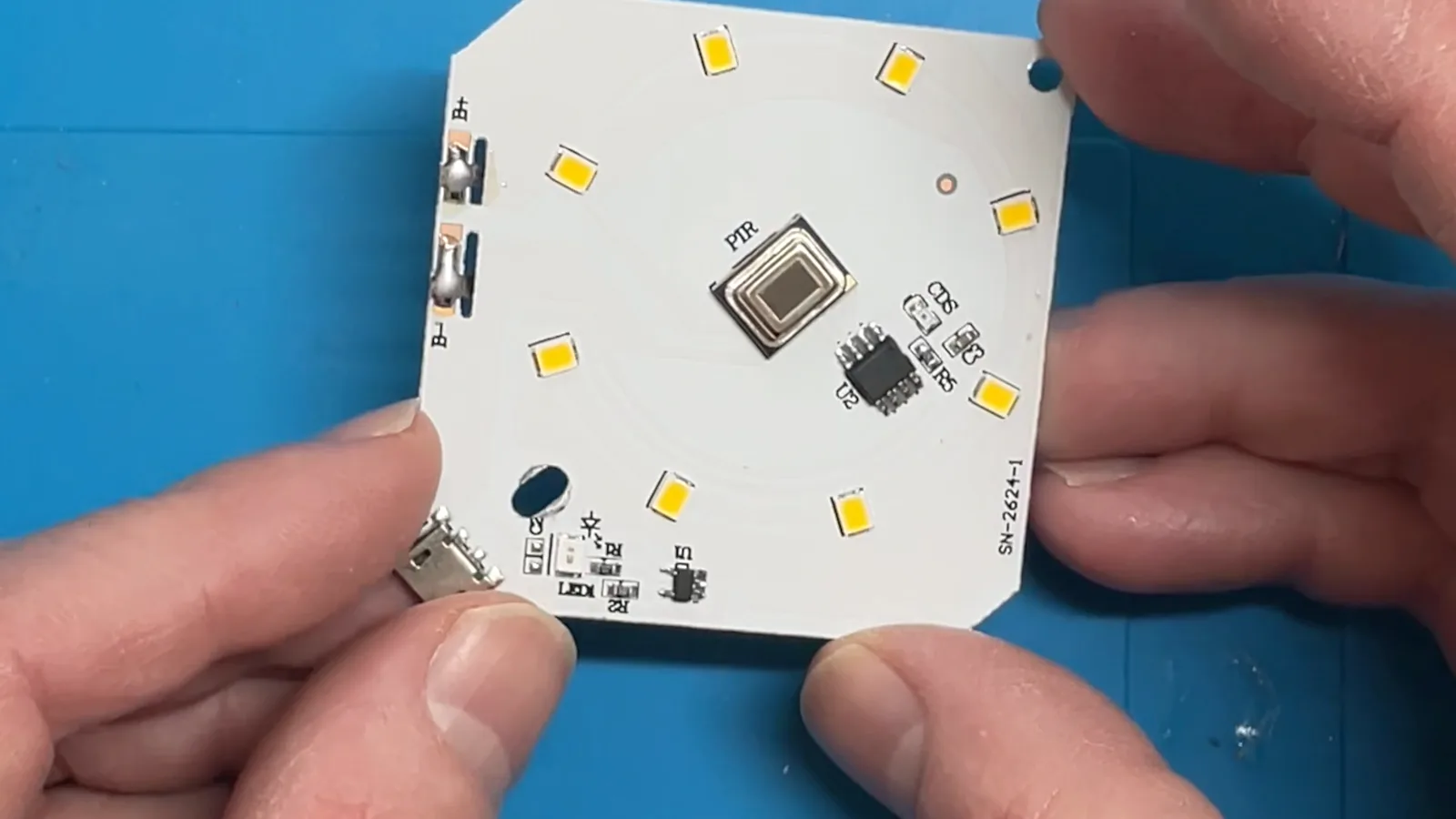
The stripped PCB showing PIR sensor, U2 chip, LDR and LEDs

Doing a Big Clive

Time to do my best Big Clive impression and reverse engineer the circuit. It’s a single layer board, so it’s all quite tractable — the positive side of every LED is tied straight to battery plus, and the negative side goes through the mystery chip down to battery minus.
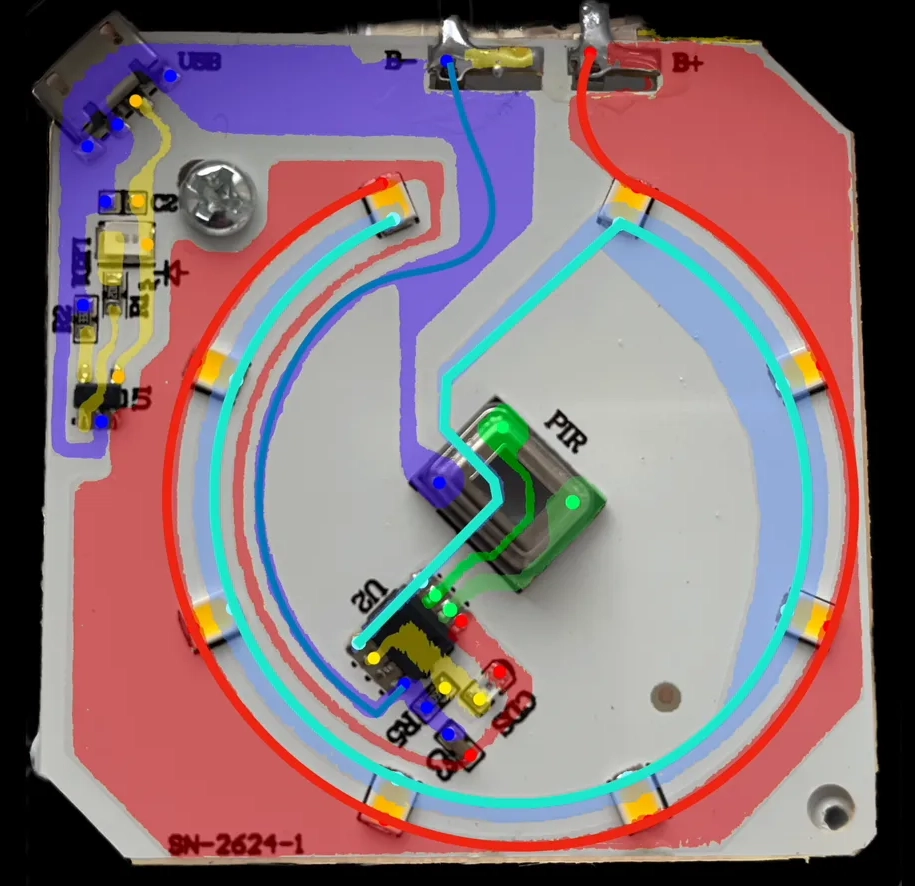
Board with tracks traced out over the top

The PIR plus and PIR minus pins go straight into the mystery chip. The LDR is part of a potential divider with R5 feeding another pin on the chip, with a decoupling cap on the rail. Over on the charging side there’s a TP4054 with a 3.3k programming resistor — that’s about 300 mA of charge current — and an LED to show the state. That’s it. Highly optimised BOM, one big mystery IC doing all the work.
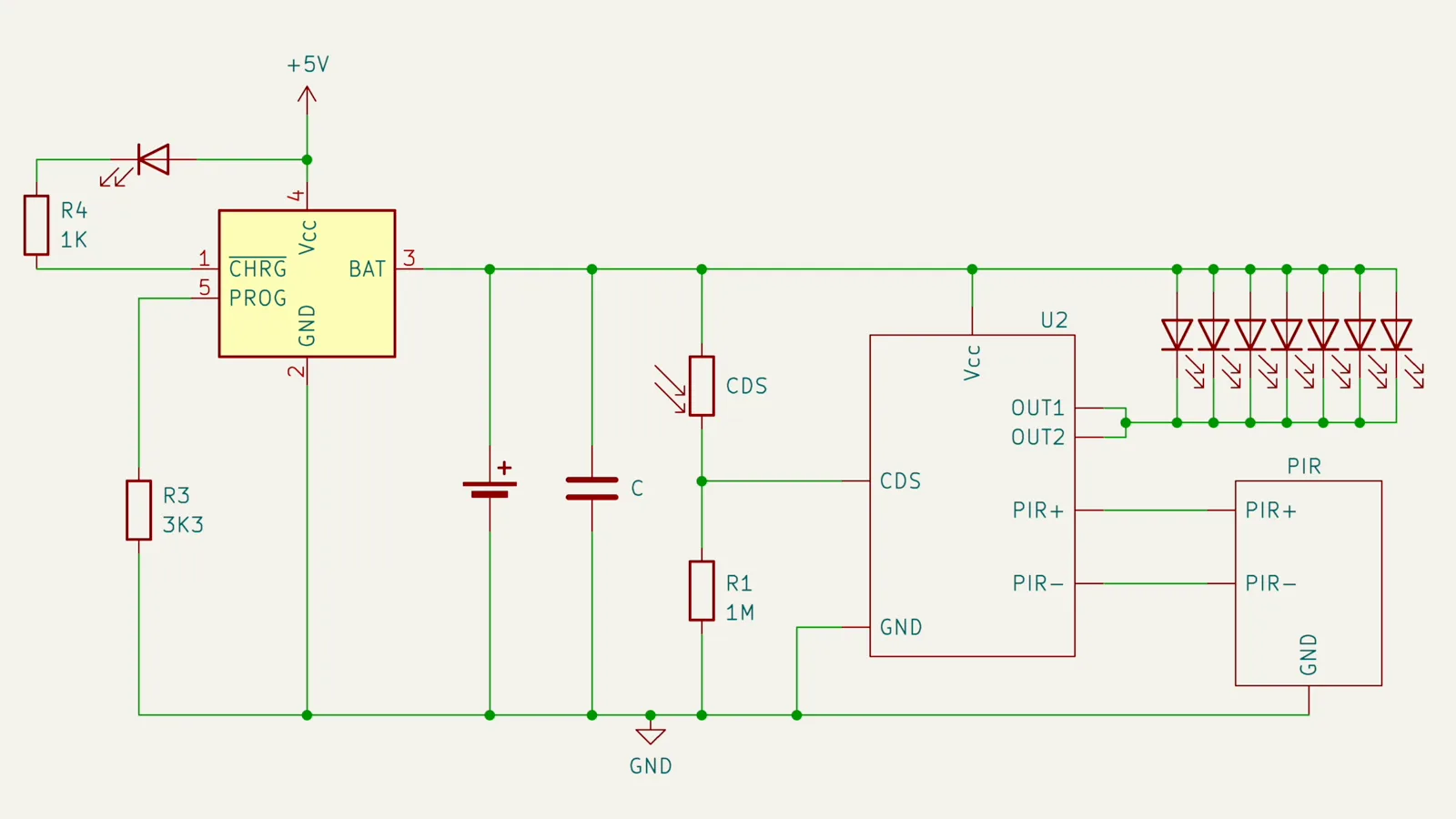
Reverse engineered schematic

What’s interesting is there’s no current limiting on the LEDs. Nothing at all. The chip is clearly driving them directly, and presumably there’s some limit built in to the chip itself.

How Much Current?

Before doing anything else, I wanted to know how hard this thing is actually driving the LEDs. Desolder the battery, hook the pads up to a bench supply with the current limit set to 100 mA, and trigger the PIR.
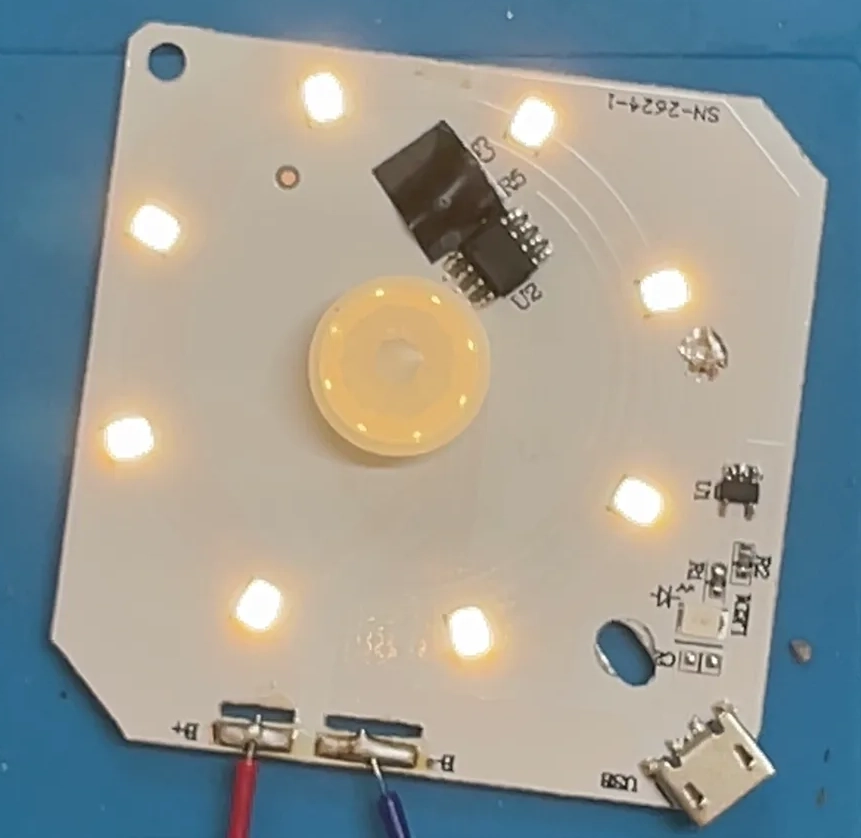
Board running on the bench supply with the LEDs lit

68 mA. So there is some built-in limiting on the mystery chip after all. This mystery IC is doing a lot of heavy lifting.

Playing with the Radar Module

These RC-WL0516 modules are lovely. They have pads for a light dependent resistor so they only trigger in the dark, and a space to solder on a capacitor to extend the timeout.

I wired one up on a breadboard, hung an LED off the output through a current limit resistor, and fed it 5 V.
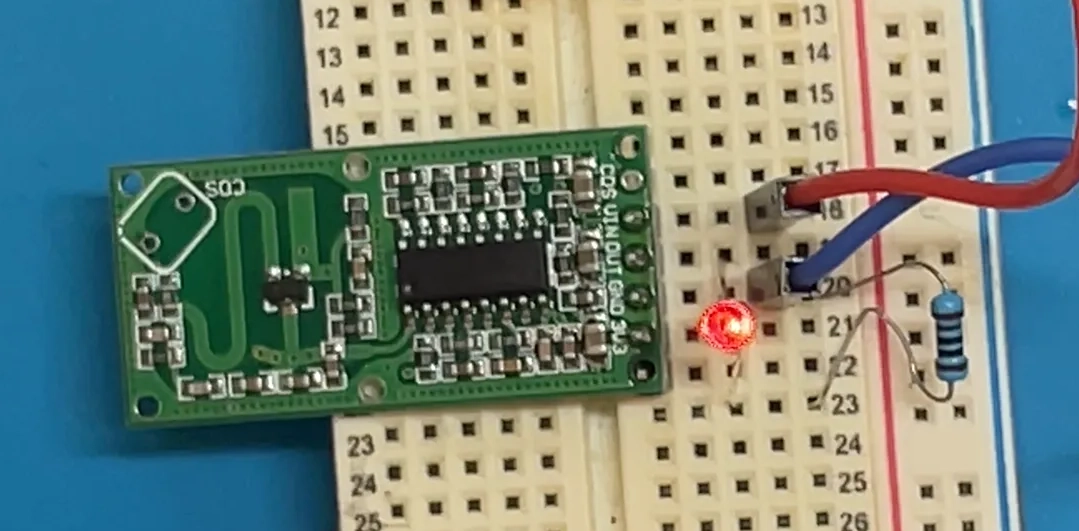
Radar module on a breadboard driving a red LED

Stand still, the LED goes off. Move, it comes back on. The default timeout is about three seconds. As I mentioned, three seconds is nowhere near enough time to get to the toilet, so I soldered a 0.22 µF capacitor to the CTM pad to extend it.
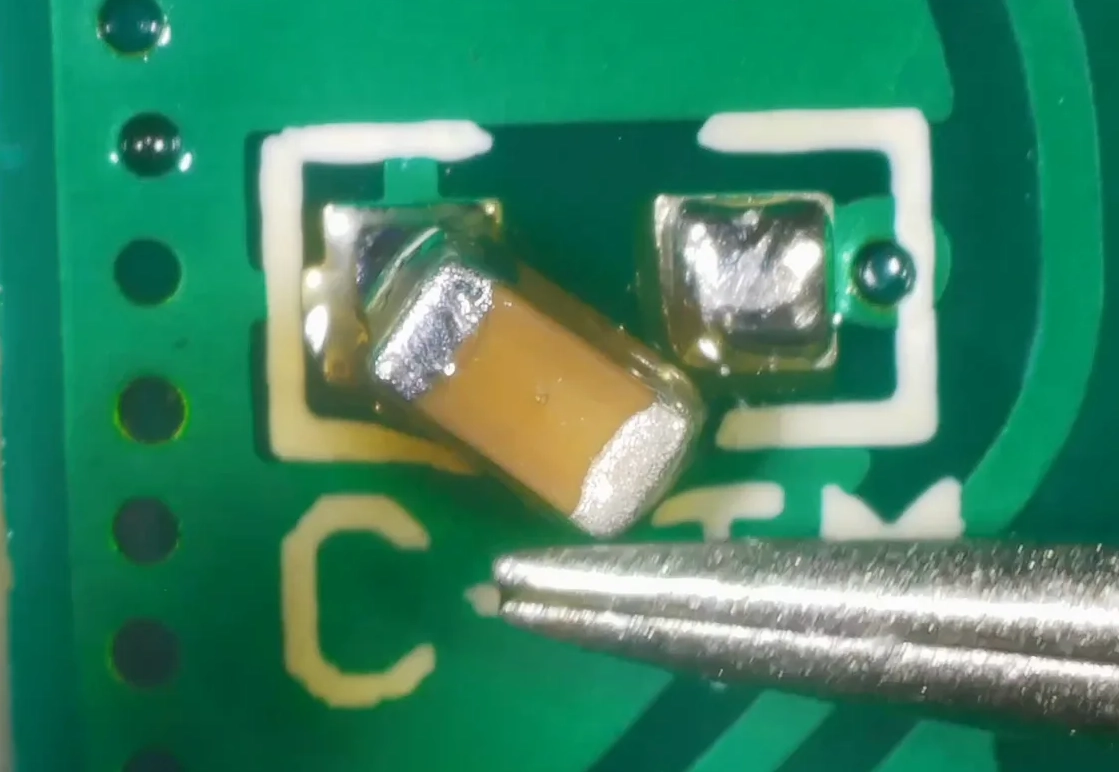
Soldering a 0.22 µF capacitor onto the CTM pad

Much better. I also wired up an LDR so it only triggers in the dark, and confirmed the motion detection works really nicely — much more sensitive than the original PIR ever was.

The Modification

Here’s the plan. Strip the PIR sensor, the mystery chip, and its supporting passives off the original board. Sit the radar module on top where there’s a nice flat empty space. Drive the LEDs through a current limiting resistor and a small MOSFET controlled by the radar module’s output pin. Power everything from the existing battery pads.
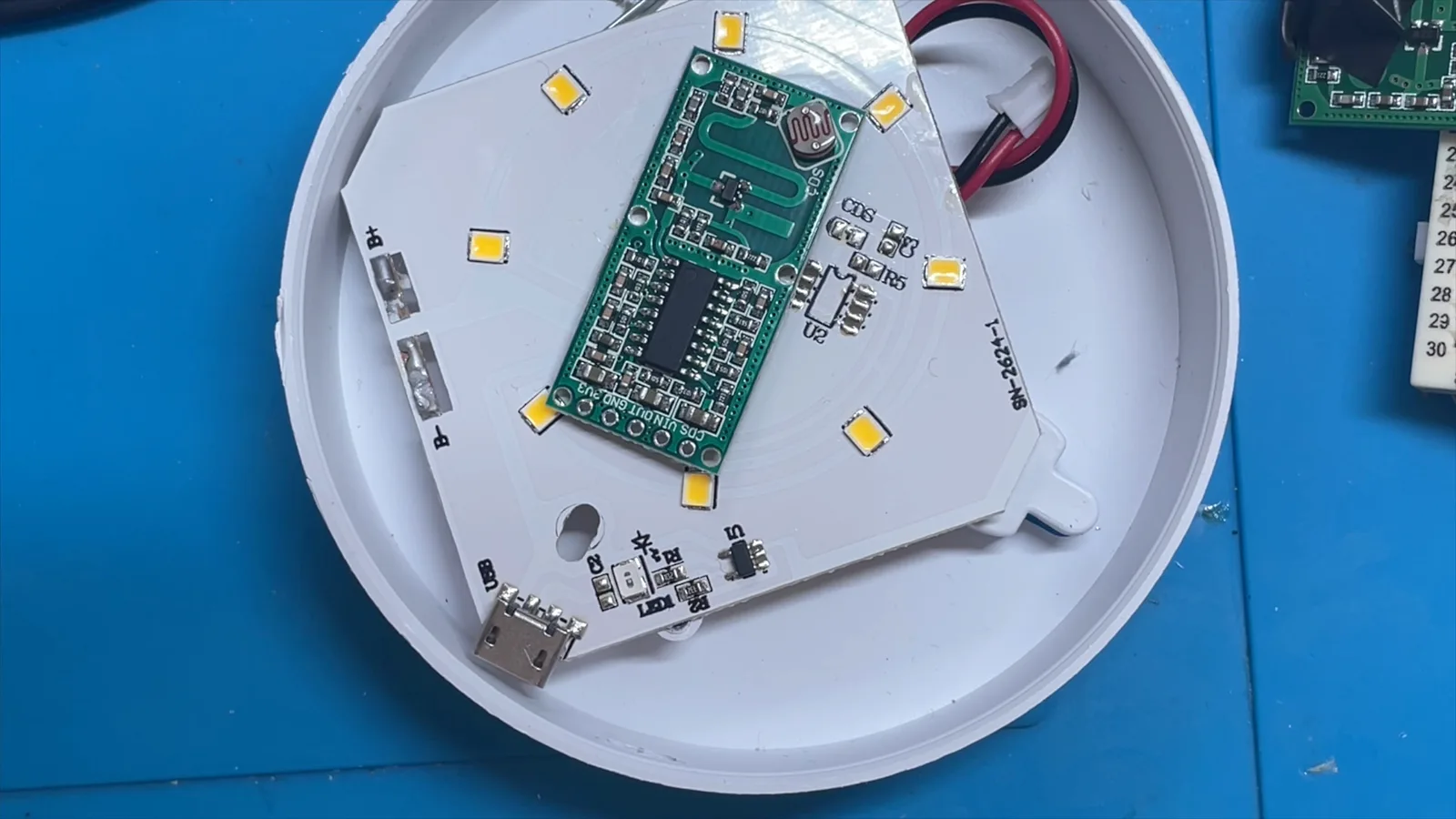
The radar module test fitted on the stripped PCB

Microscope out, and with a bit of soldering the whole thing came together more neatly than I expected. I took the opportunity to upgrade the battery too — swapping the tiny 350 mAh cell for a much more generous 820 mAh one.
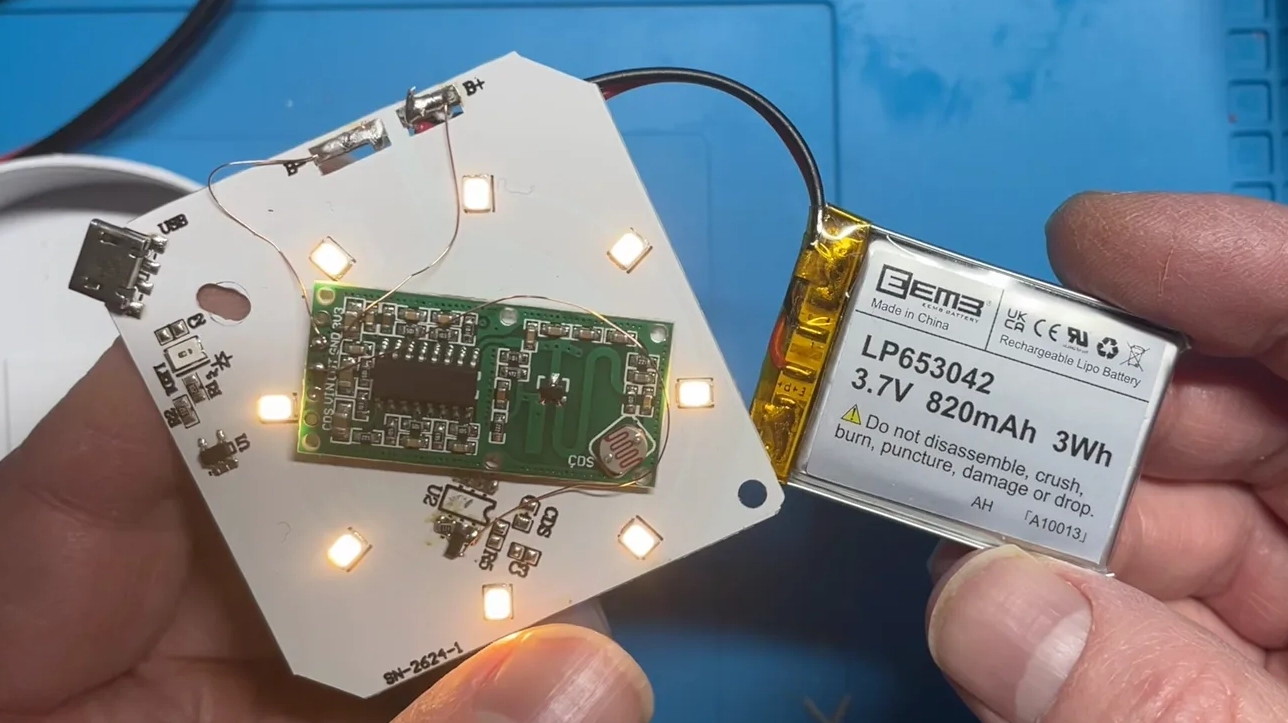
The modified board with the 820 mAh battery, LEDs lit

The board slides back into its case, the battery tucks in alongside, the USB port still lines up with the hole in the shell, the screw goes back in, the diffuser clips in, and… good as new. You’d never know anything had happened.
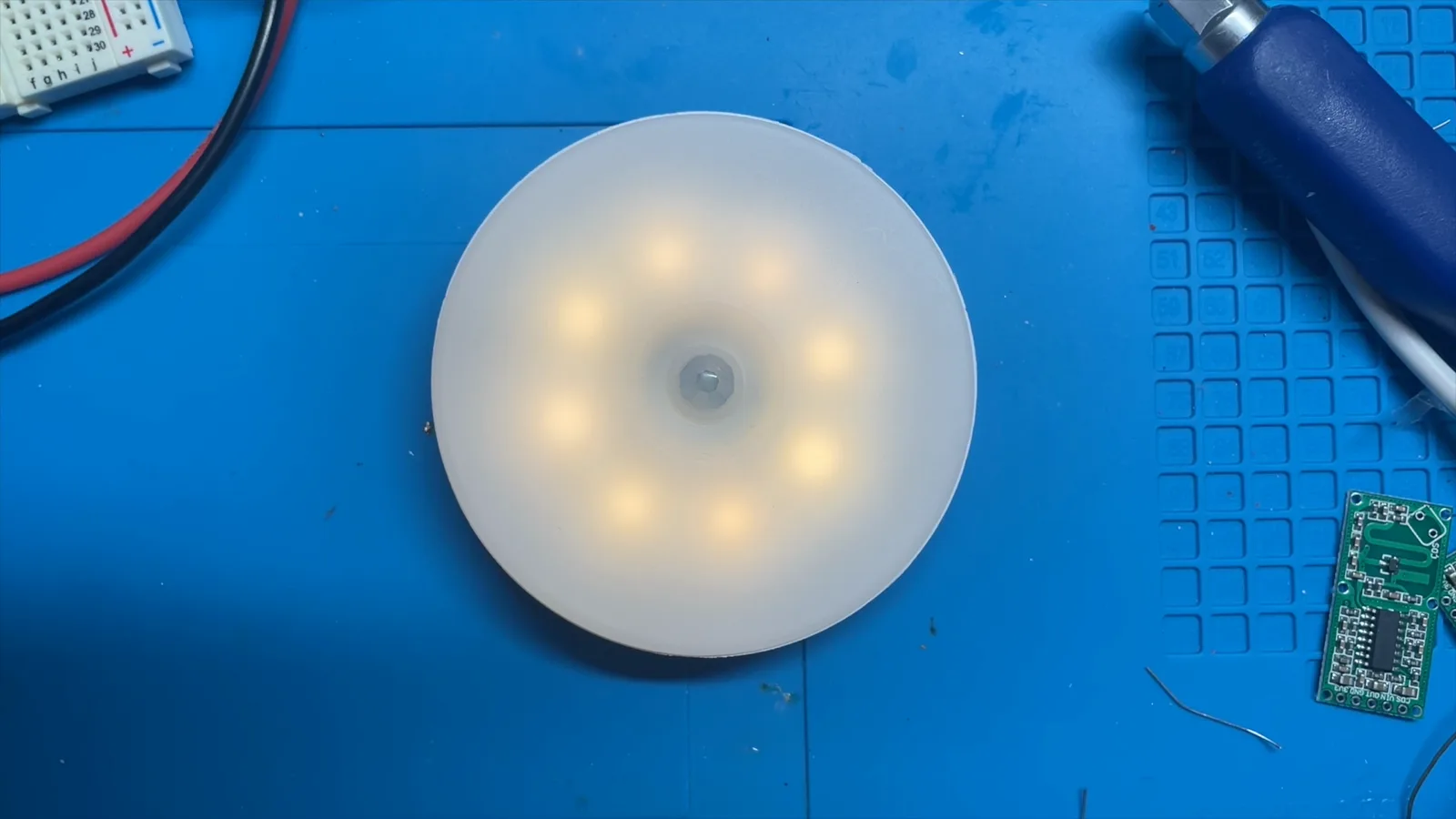
Finished, diffuser on, LEDs glowing

Does It Actually Work?

Stuck it on the stairs, turned the lights off, and waited. Walk past — it lights up. Stand still — it goes out after a sensible amount of time. Sensitivity is miles better than it was, the battery should last a lot longer, and the timeout is long enough to be useful.
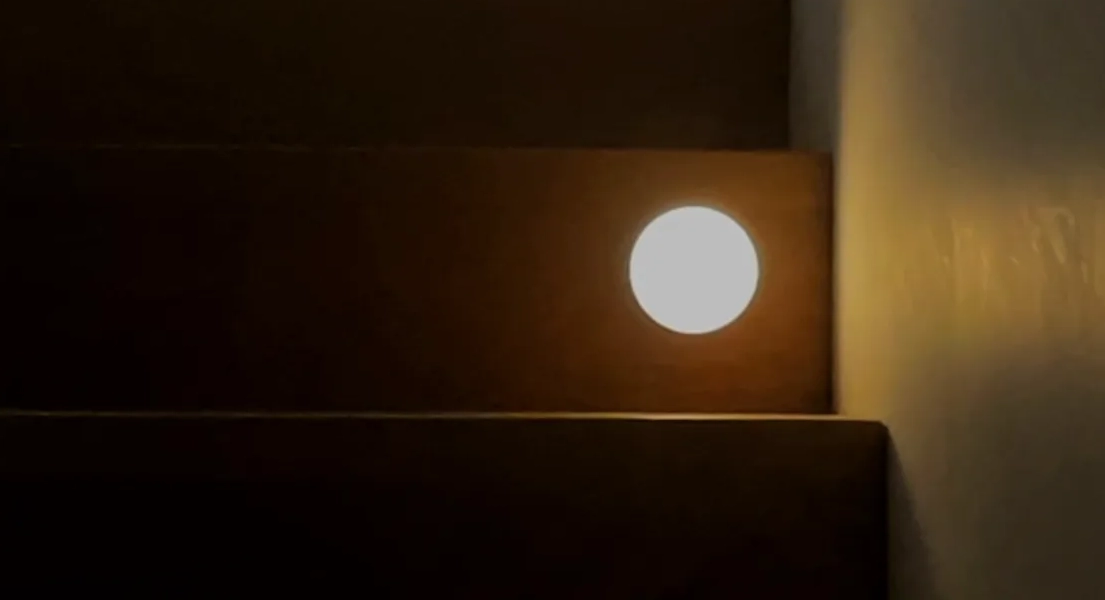
The modified night light installed on the stairs, glowing

It works. Now I just need to do the rest of them…

If you want to see the whole thing in motion — the teardown, the reverse engineering, the soldering, and the moment it finally lights up on the stairs — go and watch it on YouTube. Likes and subscribes are always appreciated.

Related Posts

Brain Surgery - I cracked open a cheap Halloween toy, found the super-simple LED + LR41 setup with the arm-as-switch trick, and swapped the ‘empty head’ for my own CH32V003 + buzzer PCB. Now it screams as well as shines—powered by a small lithium cell for extra volume because if you’re going to be annoying, do it properly. New schematic, new brains, same spooky vibes.
75% Less Power! - Saving the Planet With Motion Sensing and Image Processing - In this blog, I was dealing with a conundrum on how to reduce the power consumption of my cool magic mirror that was always on, always drawing power. I considered options such as a PIR (Passive Infra Red) sensor and a doppler radar microwave motion sensor. The latter worked brilliantly except for a few too many false positives. Things got technologically fancy when I introduced a camera for motion detection and face recognition, even recognizing who is in front of the mirror! However, while it was fascinating, it upped the power consumption which was against our original goal. After combining everything into an impressive package and even forming simple state machine, I found that the sophisticated system needed more work. Conditions like lighting and screen turn-on time presented challenges. However, it did make a significant difference - nearly running at 25% of the original power consumption. Definitely a promising and interesting project worth looking into further!
Look at my shiny crystal balls - Just upgraded my basic AliExpress crystal balls with some tech wizardry - I've thrown in an ESP32-S3-MINI, a mic, and made them battery powered. Thanks to WLED software, they're now smart and responsive! Shared the KiCAD project for fellow tinkerers. Check out my video to see these balls in action!
When “Software Bugs” Are Actually Bad Soldering - A quick MLX90640 IR camera test turned into a dead-on-I2C mystery. I ran the usual checks—addresses, pull-ups, voltages, wiring—and even fixed my forgotten UART/I2C jumper, but still nothing. A peek under the microscope revealed sketchy solder on the 3V3 LDO; a quick reflow and the sensor sprang to life. Lesson relearned: don’t trust factory soldering, look early with a microscope, and stop blaming software when the hardware’s silent.
I Built a 27V Circuit to Fix This $3 Gadget - I revived a cheap scribble pad by swapping its fried board for a tiny PCB that boosts a coin cell to 27 V—enough to cleanly reset the bistable LCD. It’s a Joule Thief with Zener regulation and twin 220 µH inductors (mounted in opposite orientations), pulling ~17 mA during charge and ~7 mA while regulating. It’s coin-cell friendly, works great, and just needs a bit of case surgery for a perfect fit.

Related Videos

Making this CR*P Night Light GOOD - I've been picking up cheap motion night lights—performance meh, battery life definitely not 'four charges a year'. So I cracked one open for a Big Clive-style reverse-engineer: TP4054 charger at ~300 mA into a tiny 350 mAh cell, an 8-pin mystery PIR/LED driver taking the PIR and LDR directly and sinking the LED cathodes. No visible current limiting on the board, but measured ~68 mA on the bench so it's baked into the chip. Then I gutted the brains, dropped in an RC-WL0516 radar sensor, added an LDR and a timing cap to stretch the ~3 s timeout, and drove the LEDs with a MOSFET and proper current limiting. Swapped in a bigger 820 mAh battery, reassembled so it still charges and looks stock—and now it actually works nicely. Also, bonus anti-subscribe jam. Good as new.
10¢ MCU Brain Surgery - CH32V003 - I crack open a punchy little toy, show how the original just squishes two contacts to light the eye LEDs off a pair of LR41s, then perform some brain surgery to cram in a tiny lithium cell and my own board that triggers lights—and an incredibly annoying tune—on each punch. It sips about 7 µA in deep sleep and wakes via a yellow trigger wire, but the soldering was fiddly and full of swearing. Tape it up, cram it back in the head, and yes, it works a treat… maybe too well, because the beeping is driving me mad.
Look at My Shiny Crystal Balls - Custom ESP32 PCB With WLED. - Step right up, folks, for the grand unveiling of my shiny new crystal balls – yes, crystal balls. I've transformed ordinary AliExpress pieces into juggernauts of light and color, all powered by the splendid WLED software. Dive deep with me into the nitty-gritty of the underlying electronics and come face-to-face with the true beauty of voltage measurements (I promise, it's more riveting than it sounds). While the original circuit boards from AliExpress might not thrill, my beefed-up version invites gasps of wonder, with microphone-controlled LEDs throwing light in a million dazzling ways. Join me as I chronicle my journey through schematic revisions, components selection, and technological trickery – in short, the wild ride that has led to this epic macOS light show.
Most Interesting Addressable LEDs that I've Ever Seen - So, I got this nifty 2x2 meter 400 LED curtain and immediately went to work dismantling it. The LED strands are tapped off the main wire, rather than daisy-chained, which is a departure from the norm. Turns out, these LEDs are pre-programmed, allowing them to intelligently latch onto the right serial data. Unraveling the control unit, we see an IR receiver and other key components responsible for driving the LED strings. Despite my misgivings about deciphering in-built Bluetooth characteristics, I hooked the circuit back up with our dependable WLED software and got some amazing grid patterns. Interestingly, the LEDs operated smoothly at 3.3V. All in all, a fun exploration of hacking this LED curtain.
Even more AliExpress gadgets - Another shamelessly overstuffed mailbag—cheers to PCBWay for fueling the bench carnage. I poked UV sensor cards with a curing lamp (they go purple then fade), sifted through robot gears, and lit some fragile LED filament letters (~2.7 V, happy around 100 mA). A USB photocatalytic mosquito trap spins at 0.02 A (teardown later), an OV7670 cam joins the ESP32/UVC experiments, and a chunky COB strip looks like a 12 V amp-gobbler. Bonus: surprisingly decent keyring torches with ‘police’ flash, a hilarious translation on a temp/humidity doodad, and watch oiler wands that are perfect for painting on solder resist—projects incoming.
HELP SUPPORT MY WORK: If you're feeling flush then please stop by Patreon Or you can make a one off donation via ko-fi
Want to keep up to date with the latest posts and videos? Subscribe to the newsletter
Blog Logo

Chris Greening


Published

> Image

atomic14

A collection of slightly mad projects, instructive/educational videos, and generally interesting stuff. Building projects around the Arduino and ESP32 platforms - we'll be exploring AI, Computer Vision, Audio, 3D Printing - it may get a bit eclectic...

View All Posts